

By Jon Kieren
You are 100 m (330 feet) below the surface.
You hear a massive cloudssibubbles behind your head. This can be resolved in two ways.
- One way to start is to signal to your buddy and maintain your position in the water column (remain stable). Reach your hands behind your head and close what you believe to be the affected valve. With your buddy, identify and isolate the malfunction. Clearly communicate the problem to the team. Everyone knows which resources have been affected (gas supply, wing, drysuit inflator, etc.). The dive ends, and you begin your ascent.
- The other way? It's when things don't go as planned.
When nothing goes as planned
When the incident occurs, your stabilization is disrupted.
- While you're reaching for the leaking tap to turn it off, you lose sight of your team. In doing so, you lose your reference points for stabilizing your position.
- As you struggle to turn off your tap, your stress level rises. CO2 begins to build up in your bloodstream as your heart and breathing rates increase.
- Tunnel vision can set in, and your buoyancy control begins to change due to the altered breathing pattern. Because of your erratic and unconscious finning, you start to ascend. You're so focused on closing the valve that you don't realize you're going up.
- When you realize you're on the climb, stress increases and panic can set in. You're no longer able to manage the situation rationally.
- Instead of correcting your stabilization and managing your ascent, you keep trying to close the tap. Your ascent becomes rapid and uncontrollable.
When you reach the surface, you are dead.
This situation can occur in a wide variety of circumstances. Small mistakes and failures can quickly escalate into an emergency. This is true whether you are on a shipwreck, in deep water, at the bottom of a cave, or even in shallow water.
When we look at diving accidents and incidents, equipment failure is almost never the final cause of a fatal incident. Such failures are often the resultssiseries of errors that precipitate an uncomfortable situation into a fatal one.
We often categorize these accidents as human error. We think, "That was stupid. That's not how I should have reacted. I should have been able to control my stabilization. I'm brilliant."
The concept of the "incident abyss"
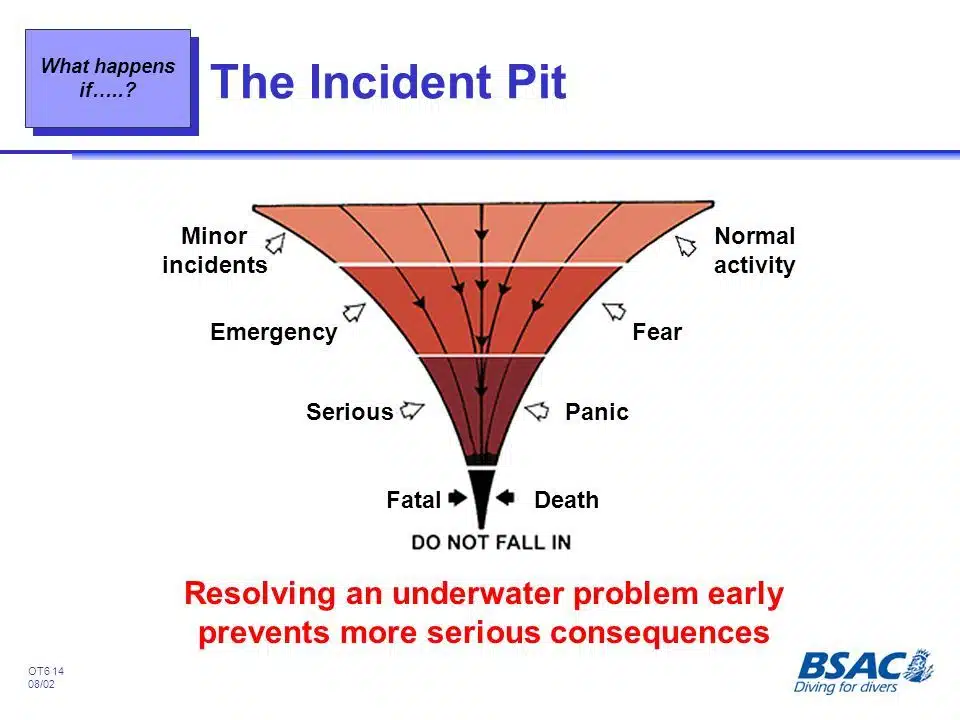
At the 1973 British Sub Aqua Club Diving Officers conference, E. JohnTowse introduced the concept of the "incident gap". This concept explains that when a problem arises and is not handled correctly, it becomes increasingly difficult to manage.
We slide deeper into the abyss, unable to pull ourselves or our teammates out of this situation, and it becomes potentially fatal. This concept is easy to visualize, but many of us tend to forget where the real failure lies: STABILIZATION.
During a dive, we operate at the first level of the incident abyss. We manage normal situations such as communication, stabilization adjustments, orientation choices, etc., with relative ease.
But what we often fail to realize is that with such intense focus on stabilization and balance management, our ability to handle complex tasks like equipment issues becomes more limited. We might be pulled from the wreck or the ascent line by the current, or we might experience an uncontrolled ascent. A minor problem can escalate into an emergency.
How to solve a problem in an extreme environment?
Start with a solid foundation of fundamentals. Practice until you master the basics, such as Valve Drills (closing the valves, manipulating the manifold valve) and S-Drills (Safety Drills: giving or receiving air in any situation), all while maintaining your body position. You must be able to react without swimming (sculling motion with the hand), finning, or focusing inappropriately on your buoyancy control and trim (balance, leveling).
Breathe gas mixtures with low END (Equivalent Narcotic Depth: Depth equivalent to air) and low density (good match of the Trimix mixture with the max depth).
By doing so, you will be able to focus on the problem at hand. You will be able to assess the situation, analyze what resources are available (within yourself or your teammate), and take the decisive action that will resolve the situation.
Most of the time, nothing will happen to you. However, problems arise when you dive; that's the nature of the sport. Failing to focus on the fundamentals is setting yourself up for failure when faced with those situations.
It is your responsibility as a diver and teammate to maintain the acquisition of these skills.